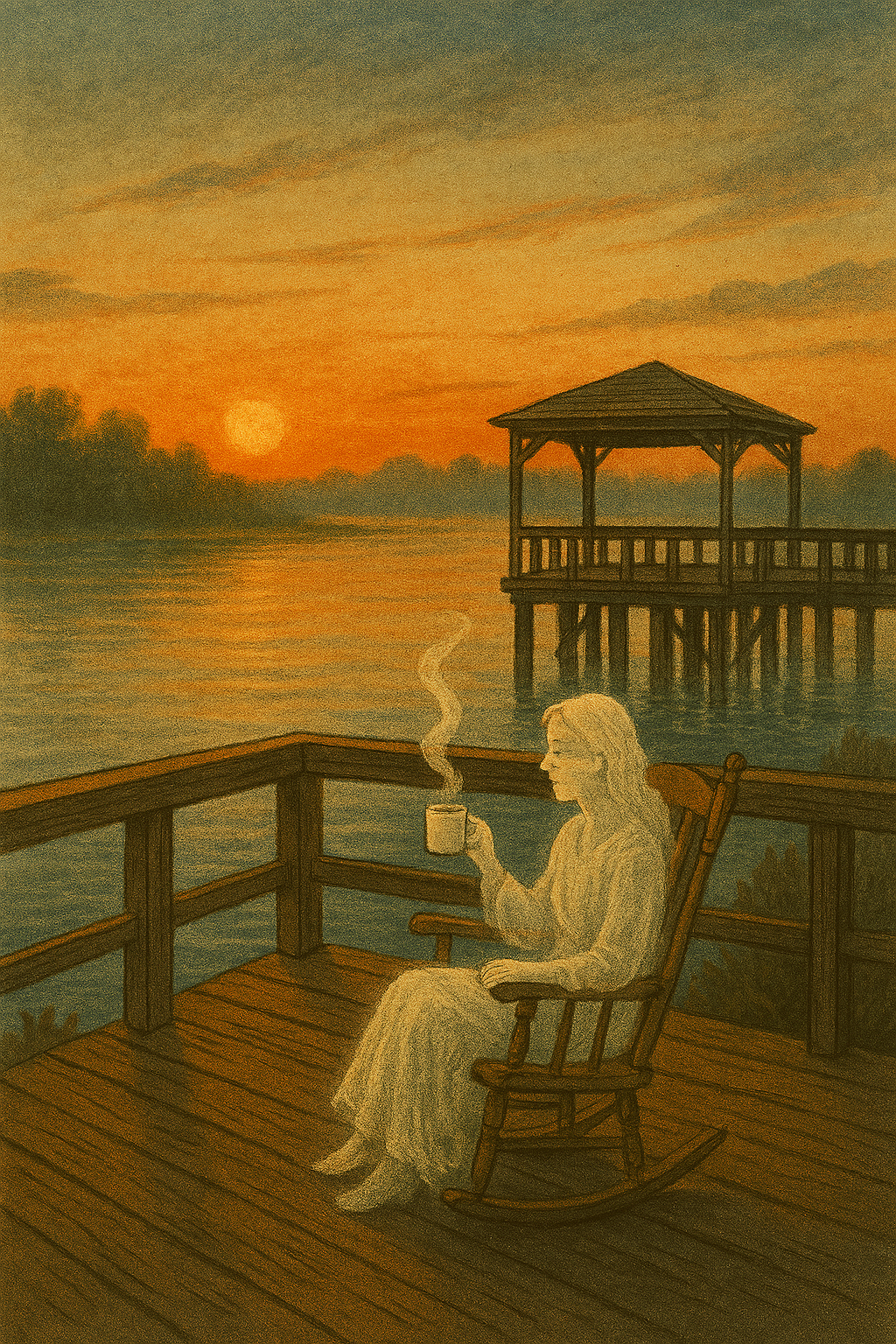
This story is dedicated to the quiet moments that hold us together—the midnight laughter, the morning coffee, and the memory of those who built our foundations.
Chapter One – Arrival and Unease
The rental stood on wooden stilts above the river, part of a weathered fisherman’s village that looked like it had been built by hand and held together by memory. The boards creaked underfoot, and the air smelled of brine, mildew, and something older—like stories that hadn’t been told in years.
As Tim arrived, he took it all in, heart heavy, suitcase in hand, mind buzzing. Aunt Joyce was gone. February 1922 to July 2012. Ninety years of life, most of it spent in Louisiana, where the Landry name still meant something. He’d come alone—his wife couldn’t make the trip—and he felt the weight of that absence like a stone in his pocket.
Libbye, his mother, and her longtime companion Trygve were already there. They’d met birdwatching with the National Audubon Society, and their love was quiet, like the way Trygve adjusted his camera lens or brewed coffee over an open flame. Libbye was grieving, but she didn’t wear it on her sleeve. She wore it in the way she folded her clothes, in the way she stared out at the water without blinking.
Thomas came last, flying in from Chicago, his laptop bag slung over one shoulder, his shoes too clean for the fish camp. He was Tim’s brother by adoption—both of them taken in as infants, raised under the same roof but shaped by different winds. Thomas was all polish and precision. Tim was all heart and history.
The camp was rustic. The beds were stiff. The river whispered beneath them. And grief hung in the air like humidity—thick, invisible, inescapable.
Chapter Two – The Walmart Run
The sheets in the rental were thin and scratchy, and Thomas had already made a comment about thread count. So Tim suggested a drive—forty miles to the next town, to Walmart, to buy new bed linens and maybe escape the heaviness for a while.
The drive was quiet at first. Tim fiddled with the radio. Thomas checked emails. The road stretched out like a ribbon of asphalt through the bayou.
“You ever think about how weird this is?” Tim asked finally. “Us. Here. For Joyce.”
Thomas didn’t look up. “It’s family. You show up.”
They wandered the aisles under fluorescent lights. Thomas was almost childlike as they walked through the superstore. It was as if seeing so many products in one place was visually overwhelming. Shopping at Walmart without a cart—that’s a deliberate move. Get in, find what you’re looking for, and get out. Thomas selected sheets like he was closing a deal. Tim lingered in the book section, thumbing through paperbacks even though his Kindle already held 800 titles.
They met at the checkout with mismatched pillowcases and a shared smirk.
“You know,” Thomas said, “this place is the opposite of everything I’d choose.”
Tim grinned. “That’s why it’s perfect.”
Chapter Three – Midnight Bubble Pop
It was 2:07 a.m. when Tim woke to a chirping sound—soft, persistent, like a digital cricket lost in the reeds. He stepped into the common room, barefoot on creaking planks, and found Libbye sitting in the dark, her face lit by the glow of her iPad.
She was playing a bubble pop game. Tap. Chirp. Tap. The screen lit up with bursts of color, and her fingers moved with quiet precision.
“Couldn’t sleep?” Tim asked.
She didn’t look up. “Just needed something light.”
Trygve stirred from the recliner, his camera resting on the table beside him. “She’s been at it since midnight,” he said, voice low. “Better than crying.”
Thomas appeared in the doorway, shirtless, hair tousled. “Y’all know it’s 2 a.m., right?”
Tim smiled. “We’re just floating.”
They sat together in silence—four souls suspended above the river, each carrying their own weight. Outside, the water lapped against the pilings. Inside, the bubbles popped like fireflies in the dark.
Chapter Four – Morning Ritual
At dawn, Trygve brewed Community Coffee with chicory over an open flame. The aroma filled the camp, earthy and familiar. Libbye hummed a hymn. Thomas checked emails. Tim read from his Kindle, the screen glowing softly in the morning light.
They gathered around the percolator, mugs in hand, the river still whispering beneath them.
“You know,” Tim said, “we’re descended from Anne Frank.” Lately, family history had started to feel less like trivia and more like truth.
Thomas raised an eyebrow. “Seriously? You didn’t know that?”
Libbye nodded. “On my mother’s side. Jewish until your father converted me.”
Trygve sipped his coffee. “History’s funny. It hides in plain sight.”
Tim looked at his brother, then at his mother. “I feel like the black sheep. You’re Beverly Hills. I’m Beverly Hillbillies.”
Thomas chuckled. “You’re the one who drove us to Walmart at midnight. That’s got to count for something.”
They laughed, softly. The kind of laugh that comes after tears, after silence, after remembering.
Chapter Five – Departure and Reflection
The service had been simple. A few hymns. A few stories. Tim sat in the back, eyes on the stained glass, thinking not of Joyce but of his father—of the goodbye he never got, of the sterile hum of cardiac monitors and the rules that kept children out. He’d always hated funerals. They felt like theater without resolution.
But this one was different. No grand speeches. Just presence. Just people who showed up, who lingered, who folded sheets and brewed coffee and played bubble pop games in the dark.
That was the real memorial.
The bags were packed. The beds stripped. The river still moved, unbothered by their presence.
Tim stood on the porch, Kindle in hand, watching the water. He thought about Joyce, about Libbye, about Trygve and Thomas. About adoption and identity. About grief and games and coffee and chicory.
They came to bury Joyce. But they found something else—connection, absurdity, grace.
As the car pulled away, Tim whispered to himself: “We came to bury Joyce, but found ourselves floating—above the water, above the sorrow, held up by pilings and memory.”